What is forex trading and how do beginners start it without losing money?
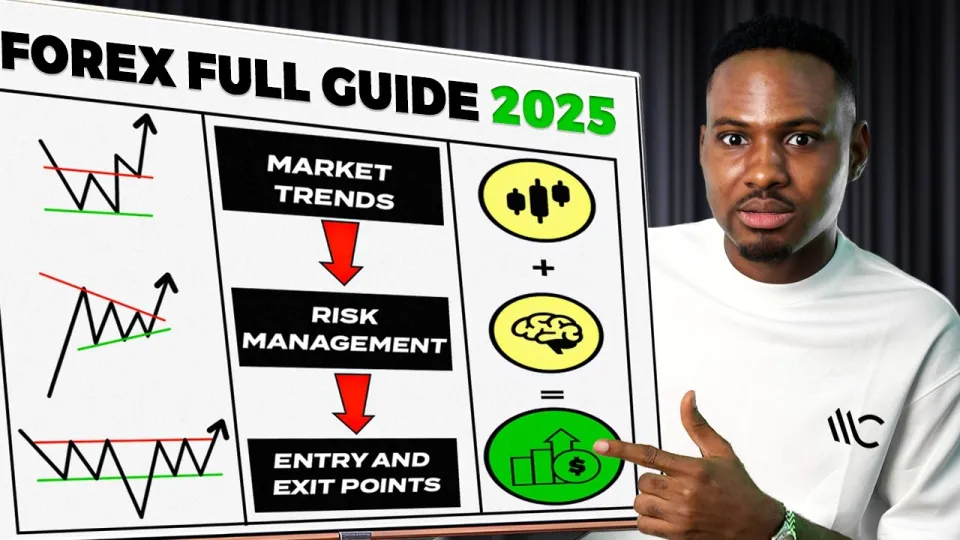
Video: How To Start Forex Trading For Beginners’ 2025 (Full Course)
Need articles like this for your video? They help promote it on YouTube and Google — order them in the Telegram bot @sat_sit_bot. Articles with your video embedded are written and posted by the bot itself — on popular topical sites (no ads). Free trial — 50 articles.
· based on the channel Jeffrey Benson Forex
Key takeaways
- Forex is an over-the-counter market where currencies are quoted in pairs such as EUR/USD; there is no single exchange.
- Trading runs 24 hours a day from Monday to Friday across four sessions: Sydney, Tokyo, London and New York.
- A beginner needs three things: a regulated broker, a trading platform such as MetaTrader 5 and a demo account for practice.
- Risk per trade is usually capped at 1–2% of the account balance, and leverage amplifies losses as fast as profits.
- Jeffrey Benson Forex offers a full beginner course plus a free daily signal channel and a paid mentorship at firepipsfx.com/plans.
Forex is the global market where national currencies are bought and sold against each other in pairs, and a beginner starts by opening a demo account with a regulated broker, learning one simple strategy and risking no more than 1–2% of the balance per trade. There is no central exchange and no opening bell: quotes move continuously from Monday morning in Sydney to Friday evening in New York. The full beginner path — from what a currency pair is to placing a first order — is laid out in the free course from Jeffrey Benson Forex, and the structured version with mentorship is available through the Fire Pips FX training plans.
What is forex and why do currencies move at all
Forex, short for foreign exchange, is the market where one currency is priced in another, and every quote reflects the relative strength of two economies. When you see EUR/USD at 1.0850, one euro costs 1.0850 US dollars; the first currency is the base, the second is the quote. A trader who expects the euro to strengthen buys the pair, and the profit or loss is calculated in the quote currency and converted back to the account currency.
Prices move because of interest rates, inflation data, employment reports, central-bank decisions and capital flows between countries. Currency trading is the largest financial market in the world, with daily turnover measured in trillions of dollars, which is why major pairs such as EUR/USD or GBP/USD are liquid and why spreads on them are usually the tightest. Unlike stocks, there is no uptrend to lean on: a currency can only rise against another currency, so traders work in both directions, going long or short.
How the forex market works around the clock
The forex market is decentralised and operates over the counter, meaning banks, brokers and electronic networks quote prices to each other rather than routing orders through one exchange. That structure explains both the round-the-clock access and the fact that there is no single official price — your broker's feed is your price.
The trading day is divided into four sessions:
- Sydney — opens the week and sets the first tone for the Australian and New Zealand dollars.
- Tokyo — Asian session, typically quieter, with activity concentrated in JPY and AUD pairs.
- London — the deepest liquidity of the day and the widest average ranges on European and major pairs.
- New York — overlaps with London for several hours, which is often the most active window for EUR/USD and GBP/USD.
Most retail traders do not need to sit through all four sessions; picking one or two consistent windows and studying how price behaves in them is far more productive than screen-watching for eighteen hours. The overlap between London and New York is the classic choice for beginners because volatility is high and spreads are still competitive.
Tools you need before the first trade
A forex beginner needs a broker account, a trading platform, a charting routine and a demo account, in that order. Everything else — indicators, signals, paid groups — is optional and should come later.
- A regulated broker. Check the licence, the regulator, segregation of client funds, withdrawal terms and the spread on EUR/USD. The broker recommended in the course is Assex Markets, registered through https://my.assexmarkets.com/auth/register?partner_code=1699134.
- A trading platform. MetaTrader 5 (MT5) is the standard: it provides charts, order types, one-click trading and a strategy tester. The broker account is linked to MT5 with the login and server details issued at registration.
- A demo account. Trade the same strategy on simulated money for at least a few weeks and keep a written log of every entry, exit and reason.
- A notebook. Beginners consistently report that writing rules and setups down by hand — sessions, entry triggers, stop placement — makes them stick far better than passive watching.
- A risk calculator. Position size follows from stop distance and risk percentage; a simple calculator removes the guesswork.
A basic strategy foundation that survives contact with the market
A workable beginner strategy is a written set of conditions for entry, exit and risk, tested on a demo account before real money is involved. Strategy is not a secret indicator; it is a repeatable decision process.
- Pick one or two pairs. EUR/USD and GBP/USD are liquid, cheap to trade and behave predictably around session opens.
- Choose a timeframe pair. Use a higher timeframe such as H4 or H1 to define direction and a lower one such as M15 to time entries.
- Define the setup. A common starting point is a trend-following pullback: price makes a higher high and higher low on the higher timeframe, pulls back to a moving average or a previous support zone, and prints a confirmation candle.
- Set the stop loss before the entry. Place it beyond the structure that would invalidate the idea, not at a round number that feels comfortable.
- Set the target. A reward-to-risk ratio of at least 1:2 means a strategy can be profitable with fewer than half of its trades winning.
- Write the rules down and follow them for 50 demo trades before judging whether the strategy works.
Placing your first trade step by step
Placing a first trade is a mechanical sequence: open the pair, choose the order type, set volume, stop loss and take profit, then confirm. In MT5 the process looks like this.
- Find the symbol in the Market Watch window and open its chart.
- Press the new-order button and check that the direction matches your plan — buy if you expect the base currency to strengthen, sell if you expect it to weaken.
- Enter the volume in lots; one standard lot is 100,000 units of the base currency, so beginners usually trade 0.01–0.10 lots.
- Attach the stop loss and take profit in price terms, then verify that the resulting risk equals your planned percentage of the account.
- Confirm the order and immediately record it in the trading journal: pair, direction, reason, risk, result.
A first trade on a live account should be small enough that a loss changes nothing about your week. The point of the exercise is to execute the process correctly, not to make money on trade number one.
Common mistakes that cost beginners money
Most beginner losses come from risk management and psychology rather than from a lack of indicators. The recurring errors are predictable and therefore avoidable.
- Risking too much per trade. A 10% risk means ten consecutive losses wipe the account; 1–2% keeps a losing streak survivable.
- Trading without a stop loss. Leverage makes an unprotected position capable of erasing the balance within minutes during a news release.
- Revenge trading. Doubling size after a loss turns a small drawdown into a blown account.
- Skipping the demo phase. Live money introduces emotions that a demo account does not, so the rules should already be automatic before real capital is at stake.
- Following signals blindly. Copying trades without understanding the setup means you cannot manage the position when the provider is asleep.
- Overtrading. More positions do not mean more profit; they mean more spread paid and less attention per trade.
Questions beginners ask most often
The questions that come up again and again in beginner communities are about time, capital and the gap between watching a course and trading profitably. How long it takes depends on the person: the mechanics can be learned in a few weeks, but consistent execution usually takes months of demo and small live trading. A common recommendation is to treat the first year as tuition, not income.
How much money is needed is the second recurring theme. Many brokers allow accounts from $10–$100, but a sensible starting balance is one you can lose without affecting your life, and position sizing matters far more than the deposit size. The third theme is fear: beginners often say they were afraid to start until someone explained the market plainly, which is exactly why structured, step-by-step material beats scattered tips.
Useful links
- Fire Pips FX plans and mentorship — the paid training track recommended by the channel.
- https://t.me/firepipsignals — free daily signal channel used to follow trades in real time.
- https://my.assexmarkets.com/auth/register?partner_code=1699134 — broker registration linked to the course.
- https://t.me/jeffreybenzhelpbot — entry point to the premium signal group.
Final thoughts on starting forex the right way
Forex rewards process discipline far more than clever prediction, and the beginner who writes down rules, risks a small fixed percentage and logs every trade will outlast the one chasing a perfect indicator. The free full course from Jeffrey Benson Forex covers the same ground in video form — what forex is, how the sessions work, which tools to install, a basic strategy and the mistakes to avoid — and serves as a solid reference to return to after each step. Start on demo, prove the process over dozens of trades, then scale slowly. If you want structure and direct guidance, the mentorship plans at Fire Pips FX are the next step after the free material.
Source: How To Start Forex Trading For Beginners’ 2025 (Full Course) · Markdown version
Questions & answers
How much money do I need to start forex trading?
Many brokers open accounts with $10–$100, but the deposit is less important than position size and risk per trade. A practical approach is to fund an amount you can afford to lose entirely and risk 1–2% of it per trade, so a losing streak does not end your trading.
How long does it take to become profitable in forex?
The mechanics take a few weeks to learn, but consistent execution usually takes months of demo trading and small live positions. Treating the first year as tuition — with a journal, fixed risk and one tested strategy — is a realistic expectation rather than a promise of quick income.
Can I copy someone else's trades instead of learning?
Copy trading and signal channels exist and can be a useful way to observe how professional setups are managed, but copying without understanding the strategy leaves you unable to manage the position if the provider is unavailable. Learning the basics first makes copied trades far easier to evaluate.
Is forex trading gambling?
Forex becomes gambling when positions are opened without a defined setup, stop loss or risk limit. With a written strategy, a fixed percentage risk per trade and a journal that records every decision, it is a probabilistic business in which a minority of winning trades can produce a positive result.